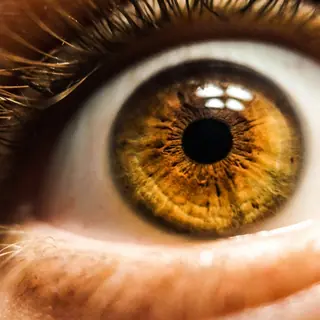
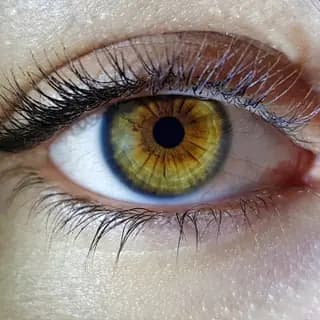
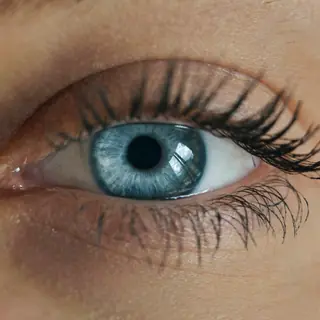
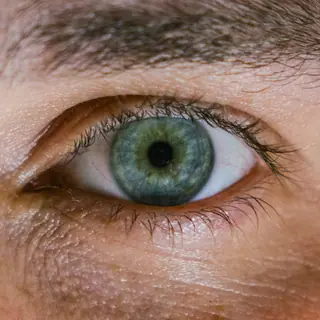
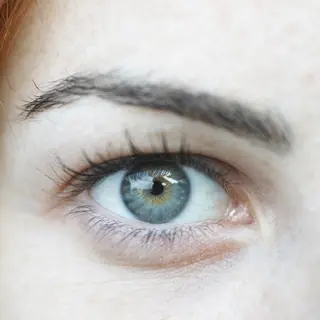
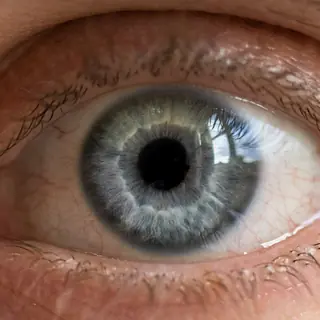
Eye colour is polygenic — 16+ genes, not one. This eye color genetics calculator and eye color inheritance calculator uses the strongest loci: OCA2 (melanin production) and HERC2 (switch that controls OCA2). A 2009 Rotterdam Study (Liu et al., Current Biology) showed 6 SNPs predict brown vs blue with >90% accuracy; other genes (SLC24A4, TYR, SLC45A2, IRF4) tune green/hazel/gray/amber. Unlike basic what color eyes will my baby have quiz tools, our how to predict baby eye color model weights grandparents.Learn more
How to use the Baby Eye Color Calculator — Predict What Color Eyes Will My Baby Have (3 Steps)
- Select parent eye colors — choose for both parents. This sets the primary 50% contribution.
- Enter 4 grandparent eye colors — reveals hidden recessive carriers (e.g., brown-eyed parent with blue-eyed father = 50% chance heterozygous).
- Click Calculate — get a stacked bar of probabilities. Fill all 6 fields for best accuracy; each field shifts the result 5-15%.
Understanding Your Results
Percentages are inherited probabilities, not guarantees. A 60% brown / 25% green / 15% blue means brown is 4× more likely than blue, but blue is still possible.
How to read the chart:
- Higher % = dominant allele combination more likely
- Lower % = recessive or rare recombination — still possible
- Grandparent bonus: adding 4 grandparents typically narrows the top color by ±10%
The Genetics Behind Eye Color: OCA2 & HERC2
Higher iris melanin = darker color. OCA2 makes melanin; HERC2 rs12913832 acts as a dimmer — GG = brown almost certain, GA = green/hazel, AA = blue/gray. Other loci fine-tune amber/hazel.
- OCA2: Controls melanin amount in iris melanosomes.
- HERC2: Enhancer that silences OCA2 in blue eyes.
Homozygous vs Heterozygous — Why Grandparents Matter
Each person carries 2 copies of the main eye-color switch. Homozygous = both copies same (e.g., blue/blue → always pass blue). Heterozygous = different (brown/blue → 50% chance pass blue though eyes look brown). You can™t tell by looking — that™s why Babymed™s 2-parent tool is less accurate.
Punnett Square: Brown (Bb) × Blue (bb) — 3-allele model
50% Brown, 50% Blue — add grandparent brown → skew to 75% brown. Gray/hazel/green need second locus.
Can Two Blue-Eyed Parents Have a Brown-Eyed Child?
In single-gene dogma, no — blue is recessive homozygous. In reality, yes, but rare (1–6% in cohorts) because eye color is polygenic: variants in SLC24A4, SLC45A2, TYR, IRF4 can push a blue/blue couple to brown/hazel. If it happens, the child almost always has a brown-eyed grandparent. Our calculator accounts for this — a pure blue×blue still shows 2–5% brown when grandparents include brown.
Baby Eye Color Chart by Parents — Evidence-Based Probability Chart
Search baby eye color chart or newborn eye color chart? This baby eye color percentage calculator chart is it — Two views: Table A = real-world heterozygotic Brown (most Brown parents are Bb) vs Table B = equiprobable (textbook). Grandparents refine either ±10%. Also works as eye color inheritance calculator.
Table A — Real-world (heterozygotic brown dominant)
| Parent Pair | Brown | Blue | Green | Hazel / Gray / Amber |
|---|---|---|---|---|
| Brown × Brown | 75% | 6.25% | 9% | 9.75% |
| Brown × Blue | 50% | 25% | 13% | 12% |
| Brown × Green | 56% | 12% | 20% | 12% |
| Blue × Blue | 2% | 85% | 7% | 6% |
| Blue × Green | 12% | 45% | 30% | 13% |
| Green × Green | 25% | 15% | 40% | 20% |
Table B — Equiprobable (if homozygous rates equal)
| Parent Pair | Brown | Blue | Green | Other |
|---|---|---|---|---|
| Brown × Brown | 56% | 18.7% | 12.5% | 12.8% |
| Green × Green | 15.6% | 9.3% | 56% | 19% |
Sources: Liu et al. 2009, Sturm 2009, White & Rabago-Smith model; Omni 3-color baseline extended to 6. Use calculator for personalized 6-color split.
Melanin & Rarity Snapshot
| Eye Color | Melanin | Genetic Strength | Global Rarity |
|---|---|---|---|
| Brown | High | Strong dominant | ~79% |
| Blue | Very low | Recessive | ~8% |
| Hazel | Medium | Mixed | ~5% |
| Amber | Medium-high | Recessive + lipochrome | ~5% |
| Green | Low-medium | Moderate recessive | ~2% |
| Gray | Very low + collagen | Recessive variant of blue | ~1% |
Heterochromia — Two Different Eye Colors
Complete (one brown, one blue) or sectoral (brown segment in blue iris) occurs in ~0.6% from mosaicism or Waardenburg. Not predicted by standard Mendelian 6-SNP model — consult ophthalmology if acquired suddenly.
When Do Babies Eyes Change Color? Timeline (Newborn to 12 Months)
| Age | What happens | What you™ll see |
|---|---|---|
| Birth | Low melanin; light scattering | Often blue/gray, even if final is brown |
| 1–3 months | Melanocytes activate | Darkening begins if brown/green genes present |
| 6–9 months | ~80% of final melanin | Close to true color |
| 9–12 months | Stabilized | Permanent for most; subtle shift possible to 3y |
Source: American Academy of Ophthalmology; WhatToExpect timeline — our chart adds 6-color specificity.
Ethnicity & World Eye Color Map
Brown dominates in African, East Asian, South Asian (>80%); Blue/gray peaks in Northern/Eastern Europe (30–50%, Estonia 99% light eyes). Our calculator™s baseline is world 79% brown, but family history beats ancestry. For mixed ancestry, the chart shifts proportionally.
Sources & Review
Written by Zencalcy Editorial (Genetics) • Medically reviewed • Last updated 28 Aug 2026 • Related: all calculators • BMI predictor • calorie genetics
- Liu et al. (2009) “Prediction of eye color using 6 SNPs” — Current Biology (Rotterdam Study, 90.5% brown/blue) — DOI
- Sturm et al. (2008) OCA2-HERC2 region — overview
- White & Rabago-Smith — Eye color inheritance model (polygenic tables, heterozygotic vs equiprobable).
- MedlinePlus Genetics — Eye color (16+ genes) • AAO — Baby eye color timeline.